
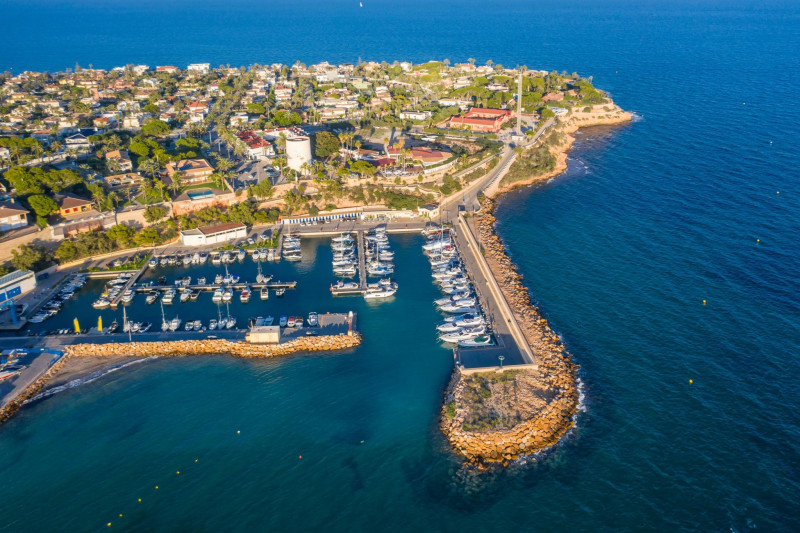
Cabo Roig sits on the Orihuela Costa strip between Torrevieja and Campoamor, a coastal pocket of the southern Costa Blanca that has drawn steady interest from British and Northern European buyers for two decades. The urbanisation combines Blue Flag beaches, a concentration of golf courses within a short drive, and a year-round residential community that swells in summer but never entirely empties in winter.
Overseas purchasers consider Cabo Roig for different reasons: some want a retirement base with reliable sunshine, others look for rental yield from the holiday market, and a smaller group treat it as a permanent relocation with children in tow. The property stock reflects that mix, ranging from older ground-floor apartments near the marina to recent-build villas on the inland fringes. Understanding what the area genuinely offers, and where the gaps lie, matters before committing capital to a market that operates differently from the UK.
Cabo Roig forms part of the Orihuela municipality in Alicante province, within the Valencian Community. This administrative structure determines which council sets property taxes, which courts hold jurisdiction over legal disputes, and where you register as a resident. If you are considering a purchase here, understanding the Spanish property acquisition process, residency requirements and tax obligations is essential. For the wider purchase process, Sunshine Homes' Complete Costa Blanca Buyer Guide 2026 covers legal steps, buying costs and practical considerations for overseas purchasers.
Why Cabo Roig Attracts Overseas Buyers

Three factors explain most purchase decisions. Buyers comparing lifestyle with live stock can also browse current Cabo Roig property. First, the climate: Cabo Roig records more than 300 days of sunshine annually, with July and August temperatures regularly exceeding 30°C and winter months mild enough that outdoor dining remains comfortable. Second, the beaches are accessible, clean and managed to a standard that earns repeated Blue Flag recognition. Third, the area has matured into a functioning town rather than a pure resort, meaning supermarkets, medical centres and year-round services exist alongside the seasonal beach bars.
The buyer profile skews heavily towards the over-50s, though young families do appear, particularly those with remote-work arrangements or business income that permits six-month splits between the UK and Spain. Northern European buyers, especially from the UK, Ireland, Belgium and Scandinavia, dominate the ownership base. Spanish nationals represent a smaller share, often purchasing holiday apartments for domestic tourism.
Price competitiveness compared to other Mediterranean coastal markets also plays a role. While Cabo Roig is not the cheapest pocket of the Costa Blanca, it sits below equivalent beachfront locations in Marbella, Mallorca or the French Riviera, making it accessible to middle-income retirees and second-home buyers working within modest budgets.
Cabo Roig vs Neighbouring Coastal Towns
| Feature | Cabo Roig | Torrevieja | Campoamor |
|---|---|---|---|
| Blue Flag Beaches | 1 main beach (additional coves nearby) | 5 beaches | 3 beaches |
| Drive to Alicante Airport | ~45 minutes | ~40 minutes | ~50 minutes |
| Golf Courses Within 10km | 4 (Villamartin, Las Ramblas, Campoamor, Las Colinas) | 2 | 3 |
| Average 2-Bed Apartment Price (at time of writing) | Varies by season and condition; typically €140,000–€250,000 | €110,000–€200,000 | €160,000–€280,000 |
Cabo Roig offers a balance between the larger infrastructure of Torrevieja and the quieter, slightly more upmarket feel of Campoamor. Buyers who want a broader local comparison can also read Sunshine Homes' Living in La Zenia guide. Torrevieja provides better year-round amenities and a larger hospital, while Campoamor appeals to buyers prioritising tranquillity and proximity to premium golf. Cabo Roig sits comfortably in the middle, close enough to both for convenience without the density or noise of Torrevieja's town centre.
The Beaches: Blue Flag Coast and Coastal Walks
Cabo Roig beach itself is a compact cove of fine sand, sheltered by low rocky headlands that keep the water calm. Lifeguard cover runs from June through September at Cabo Roig beach, as well as at neighbouring Playa Flamenca and La Zenia. Blue Flag status confirms water quality, accessible facilities and environmental management meet European standards. Beach bars operate through the summer, and sunbed hire is available, though free towel space remains plentiful outside peak weeks.
The real draw for many residents is the clifftop coastal path that links Cabo Roig to neighbouring coves at La Caleta, Cala Capitan and further south towards Campoamor. The route is paved, mostly flat, and offers sea views without the need to descend steps every few hundred metres. Runners, dog walkers and evening strollers use it year-round. The path also connects to additional Blue Flag beaches at Playa Flamenca and La Zenia, giving residents variety without needing a car.
For families, the shallow entry and generally calm conditions make Cabo Roig beach suitable for younger children, though supervision remains necessary as with any open water. Rock pools at the cove edges attract snorkellers and children exploring marine life. The beach does get crowded in July and August, particularly during Spanish public holidays, so locals often shift their routines to early morning or late afternoon.
Best Time to Visit or Buy in Cabo Roig

The property market sees its highest activity in spring, typically March through May, when Northern European buyers visit after winter and begin serious negotiations. Prices tend to hold firm during this window as demand peaks. Autumn, particularly September and early October, offers a second opportunity: the weather remains warm, beaches are less crowded than in summer, and some sellers who listed in spring but did not close a deal become more flexible.
For those testing Cabo Roig before committing to a purchase, May and September are ideal. If the area feels right, compare that experience against live Cabo Roig property for sale before deciding which micro-location suits you. The beaches are quieter than July and August, restaurants and amenities remain fully operational, and temperatures sit comfortably in the mid-20s. Avoid August if you dislike crowds: the combination of Spanish domestic tourism, European school holidays and peak expatriate occupancy pushes beaches, roads and restaurants to capacity. January can also disappoint, as some bars and seasonal businesses close for maintenance, and the expatriate population thins out, leaving the town quieter than many expect.
If your goal is year-round living rather than a summer base, visit during the winter months to assess whether the pace and available services meet your expectations. Many buyers make the mistake of purchasing after a July visit, then discover that the vibrancy they experienced does not carry through to February.
Local Amenities and Infrastructure
Cabo Roig itself is small. The core urbanisation includes the marina area, a handful of street-side cafés, a couple of supermarkets and a Friday street market that draws vendors selling produce, clothing and household goods. For broader shopping, residents drive five minutes to La Zenia Boulevard, an open-air retail centre with UK supermarket chains, high-street fashion outlets, a cinema and a children's play zone. Sunshine Homes' La Zenia lifestyle guide explains how the neighbouring area compares for day-to-day living. The boulevard opened in 2012 and remains the main non-beach social hub for the expatriate community.
Restaurants cluster around the marina and the Cabo Roig strip, offering predictable Spanish staples alongside British, Italian and Indian cuisine. Quality varies, and many establishments cater explicitly to the tourist and expatriate palate rather than a local Spanish clientele. Cabo Roig is not a destination for serious gastronomy, but it covers everyday dining needs without drama.
Banking is straightforward: major Spanish banks operate branches in nearby Playa Flamenca and Torrevieja, and ATMs are plentiful. English-speaking staff are common in branches close to expatriate neighbourhoods, though fluency in Spanish remains advantageous for nuanced financial matters, particularly mortgage applications or tax queries.
Golf is a significant part of the local economy. Cabo Roig sits within a ten-minute drive of several 18-hole courses, including Villamartin, Las Ramblas, Campoamor and Las Colinas. Many property developments market themselves explicitly to golfers, and the sport forms a core social activity for a large segment of the expatriate retiree population.
Schools, Healthcare and Practical Considerations
Schools
International schooling options exist but require a commute. The nearest British-curriculum school sits in Torrevieja, roughly 15 minutes by car, and another well-regarded international school operates in San Miguel de Salinas. Spanish state schools are free and available to all residents, including expatriate children, but language immersion can be challenging for older pupils arriving mid-academic year without prior Spanish.
Healthcare
Healthcare provision divides into public and private. Spain's public health system (SNS) is accessible to UK residents who have registered and obtained the necessary documentation. UK nationals who hold a valid GHIC (Global Health Insurance Card, which replaced the EHIC for UK citizens post-Brexit) can access emergency care, though the GHIC does not cover routine or pre-planned treatment in the same way that full residency and registration in the Spanish system does. Waiting times for non-urgent procedures in the public system can stretch several months.
Many expatriates take out private health insurance to access quicker appointments and English-speaking consultants. Private policies from Spanish providers typically range from €50 to €150 per month for an individual, depending on age, pre-existing conditions and level of cover. International policies often cost more but may include repatriation and cover across multiple countries.
Quirónsalud Torrevieja, one of the region's main private hospitals, is located approximately 12 minutes by car from Cabo Roig and offers a full range of specialisms, including emergency care, surgery, maternity and diagnostics. English-speaking staff are available, and many UK insurers have reciprocal agreements with the hospital. For routine consultations, private clinics in Playa Flamenca and Orihuela Costa provide GP services, dental care and physiotherapy.
Pharmacies are plentiful and well-stocked, and over-the-counter medication availability is broader than in the UK. Pharmacists often speak functional English and can advise on minor ailments without the need for a GP appointment.
Transport
Driving is effectively essential. While Cabo Roig is walkable for beach access and immediate errands, grocery shopping, healthcare appointments, airport runs and any activity beyond the immediate strip require a car. Public bus routes connect Cabo Roig to Torrevieja and other coastal towns, but frequencies are limited and timetables inconvenient for daily reliance. Alicante Airport sits approximately 45 minutes north by car, and Murcia-Corvera Airport is around 40 minutes south, offering flexibility for international travel.
Cost of Living in Cabo Roig
Day-to-day expenses in Cabo Roig are generally lower than in the UK, though some costs, particularly those tied to property ownership, require careful budgeting.
IBI (Impuesto sobre Bienes Inmuebles) is the annual property tax, equivalent to UK council tax. Rates vary depending on property value and location, but a typical two-bedroom apartment in Cabo Roig incurs an IBI bill of around €250 to €400 per year. Larger villas can reach €600 or more. IBI is billed annually and collected by Orihuela council.
Utility bills for a two-bedroom apartment typically run €80 to €120 per month for electricity, depending on air conditioning use in summer and heating in winter. Water bills are lower, usually €30 to €50 every two months. Internet and mobile packages are competitive, with fibre broadband and phone bundles available from around €40 per month.
Car insurance costs less than in the UK for most drivers, particularly those over 30 with no claims history. Annual premiums for comprehensive cover on a standard saloon or hatchback typically range from €300 to €600, though younger drivers or those with high-value vehicles pay significantly more.
Dining out remains affordable compared to UK city prices. A three-course meal for two in a mid-range restaurant, including a bottle of house wine, costs approximately €40 to €60. Beachside cafés charge €2 to €3 for coffee, and a menú del día (fixed-price lunch menu) runs €10 to €15 per person.
Groceries are broadly similar to UK supermarket prices, with fresh produce, seafood and local wine notably cheaper, while imported British brands and processed foods cost more. A weekly shop for two adults typically ranges from €60 to €90, depending on dietary preferences and reliance on imported goods.
Community fees for apartment blocks, which cover shared pool maintenance, gardens, insurance and sometimes water, vary widely but typically fall between €40 and €120 per month. Gated developments with extensive facilities can exceed €200 monthly.
A Live Cabo Roig Property Example
Sunshine Homes currently markets a two-bedroom corner apartment in Playa Marina I on the Cabo Roig Strip. The live listing places it within walking distance of restaurants, shops and everyday services, with the seafront and beaches nearby.
View the Cabo Roig Strip apartment
The Property Market in Cabo Roig

The housing stock skews towards apartments and townhouses built in phases from the late 1990s through to the mid-2000s, with newer stock also available across the wider Orihuela Costa market. Buyers can browse current Sunshine Homes property for sale in Cabo Roig rather than relying on fixed historical price ranges. Detached villas exist, particularly on the inland side of the N-332 road, but the majority of listings are two- or three-bedroom apartments in low-rise blocks with communal pools.
Prices at the time of writing range from around €120,000 for a two-bedroom ground-floor apartment requiring some updating, up to €500,000 or more for a modern villa with private pool close to the coast. Beachfront penthouses and larger detached properties with sea views command premiums, occasionally exceeding €700,000.
Rental potential exists for some properties, but buyers should assess the individual home's legal status, community rules and actual operating costs. Sunshine Homes' Costa Blanca Property Investment Guide 2026 provides wider investment context. Occupancy rates are highest from May through September, and many owners operate a mixed-use model, occupying the property themselves for part of the year and renting it for the remainder. Gross yields typically fall in the 4-6% range before costs, though management fees, community charges and maintenance eat into net returns.
Community fees are an important budget item. Older developments with lower monthly fees may also face periodic levies for major repairs, such as roof replacement or pool refurbishment. Newer complexes often charge higher monthly fees but include better facilities and more robust reserve funds.
Resale properties dominate the market, though new-build developments continue to appear on available land parcels. Off-plan purchases carry the usual risks, including construction delays and developer solvency, though Spain's regulatory environment has tightened significantly since the pre-2008 boom.
Explore Orihuela Costa with Sunshine Homes
View current Cabo Roig properties
Explore the Orihuela Costa area guide
Read the La Zenia lifestyle guide
View a current Aguamarina / Campoamor apartment
Read the Costa Blanca Buyer Guide
Read the Costa Blanca Property Investment Guide
Contact Sunshine Homes or call +34 711 022 224 to discuss suitable coastal homes in Cabo Roig and Orihuela Costa.
Frequently Asked Questions
Is Cabo Roig suitable for year-round living?
Yes, though the experience differs from summer. Winter months are mild, with daytime temperatures typically between 15°C and 20°C, and most amenities, supermarkets and healthcare facilities remain open. Some seasonal restaurants and beach bars close from November through March, and the expatriate population thins noticeably. If you value a quiet, slower pace and do not rely on a bustling social calendar, year-round living works well. Families with school-age children find it more practical than retirees, as schools and children's activities continue without interruption.
Do I need a car in Cabo Roig?
Effectively, yes. While the immediate beach area, a couple of supermarkets and nearby bars are walkable, anything beyond, such as larger shopping trips, healthcare appointments, airport transfers or exploring inland towns, requires a car. Public buses connect Cabo Roig to Torrevieja and other coastal towns, but services are infrequent and inconvenient for daily use. Taxis and ride-hailing apps operate in the area but add up quickly if used regularly.
Which beaches have lifeguards?
Cabo Roig beach, Playa Flamenca and La Zenia all have lifeguard cover during the main season, typically from June through September. Hours usually run from mid-morning to early evening, though exact schedules vary year to year. Outside those months, beaches are unattended. Smaller coves along the coastal path, such as La Caleta and Cala Capitan, generally do not have lifeguard services even in summer.
How far is Alicante Airport?
Alicante-Elche Airport sits approximately 45 minutes north of Cabo Roig by car, depending on traffic. The drive follows the AP-7 motorway, which is a toll road, or the slower, free N-332 coastal route. Murcia-Corvera Airport is roughly 40 minutes south and serves some budget carriers, offering an alternative depending on flight availability. Both airports handle year-round international connections, with peak summer frequencies from UK regional airports.
View Cabo Roig Property With Sunshine Homes
Cabo Roig works best when the location, property type and year-round lifestyle fit how you actually plan to use the home.
Browse current Cabo Roig property
Read the Costa Blanca Buyer Guide
Contact Sunshine Homes or call +34 711 022 224 to discuss your Cabo Roig shortlist.